
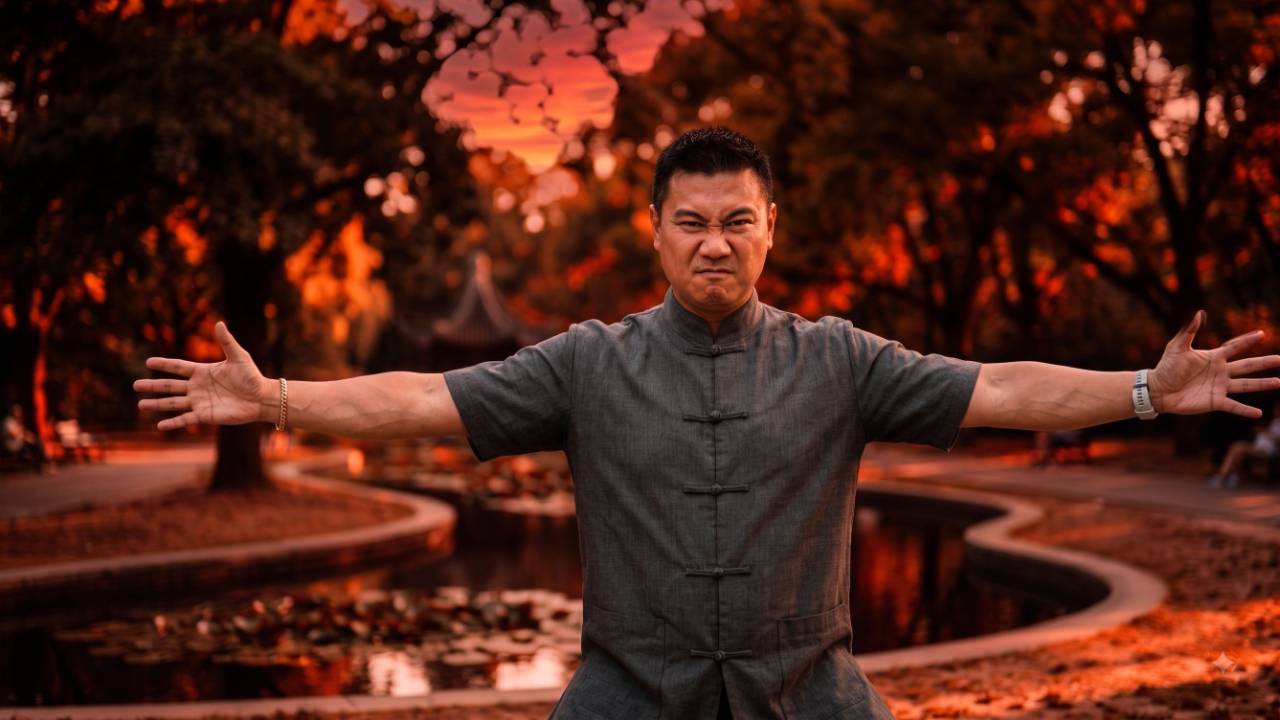
Nei Gong inside Shi Jing Jin (The Elastics Energy)
Aug 31, 2026Neigong: The Mastery of Elastic Energy and the Third Pulling Sensation
While Qigong focuses on the opening and clearing of the physical and energetic body, Neigong is the profound science of internal contraction and elastic power. In this advanced stage of training, we move beyond simple stretching. We are now forging a highly pressurized, interconnected web of fascia, tendons, and muscle fibers that operate with the dynamic, snapping force of a drawn bowstring.
To cultivate this elastic energy, the practitioner must master the simultaneous forces of extension and contraction. You must fully extend your intent and structure through your fingertips, while simultaneously sinking your weight and heavy intent halfway down into the earth. This opposing duality creates the baseline tension required for internal power.
The Progression of Joint Awareness
True Neigong requires granular, conscious control over every joint. In the beginning, your focus is broad: you extend through the fingertips on both sides while feeling a heavy, sinking sensation anchoring down through your entire spine and into the root.
As your internal awareness sharpens, you must separate this connection. You break the focus down, isolating the elbow and the shoulder, and eventually narrowing it all the way down to the micro-adjustments of the wrist position. Proper body alignment becomes paramount. Without absolute structural integrity, the internal pressure bleeds out, and the elastic connection snaps.
The "Third Pulling Sensation"
The hallmark of this Neigong phase is discovering the "third pulling sensation" within every joint complex. If the hand extending is one point of tension, and the shoulder sinking is the second, the joint between them (the elbow) must not be a dead, locked hinge. Instead, the elbow creates a third, distinct vector of pull—expanding outward or bowing to create structural roundness. This concept applies universally throughout the body: you must locate and activate this third pulling center in the spine, the hips, the knees, and the ankles, transforming a simple straight line into a vibrant, three-dimensional web of elastic force.
The Six Sets: Applying Neigong to the Shi Jing Jin
In this phase, the outer movements of the Shi Jing Jin remain structurally similar, but the internal engine completely changes. We are now focusing on deep muscular pulling, fascial wrapping, and joint expansion.
Set 1: The Central Pull
The first movement establishes the core baseline of elastic energy. As the arms fully extend from both sides, the intention shifts away from the extremities and dives deep into the core. The primary pulling sensation is anchored directly at the absolute center of the body. You are not pushing your hands forward; your center is expanding, and that deep internal contraction forces the arms to float outward. The spine sinks, the fingers extend, and the center of the torso acts as the tightly wound origin point from which all fascial lines are pulled taut.
Set 2: Sinking the Extremities
In the second set, as the palms extend to the sides of the body, the focus transitions to the extremities and their connection back to the root. The wrists and shoulders reach a state of full, vibrant extension. However, the internal work requires a deliberate, heavy sinking of the wrists. As the wrists drop, you must slowly and consciously sink the elbows, followed immediately by the shoulders. This sequential sinking creates a deep, painful, yet vital pulling sensation through the forearms, under the biceps, and across the chest, teaching the tendons how to stretch while bearing the heavy, sinking weight of the joints.
Set 3: Rotational Sinking
With the hands extended forward, the third set introduces the Neigong mechanics of torsion. The focus is on the active, downward sinking combined with the opposing rotation of the elbow and the shoulder. This is where the differential gear system becomes heavy and loaded. The inward rotation of the hands and the outward rotation of the shoulders create a deep fascial wringing effect. This loaded rotation solidifies the connection of the entire body, ensuring that the pulling sensation travels from the center, through the twisting joints, and out to the fingertips without a single break in the structural chain.
Set 4: The Upward Arc and the Third Point
As the hands extend upward with the palms facing the sky, the Neigong application becomes intensely demanding. The primary anchor is the latissimus dorsi (lat) muscle, which must pull down heavily against the upward reach of the hands.
Here, the concept of the "third pulling sensation" is perfectly realized. The hand is point one (reaching up). The shoulder/lat is point two (pulling down). The elbow becomes the vital third point. The elbow must actively pull outward, resisting both the hand and the shoulder. This outward pull creates a distinct roundness—a structural bow—that amplifies the pulling sensation of the center, running powerfully from the hand, through the bowing elbow, and down into the anchoring shoulder.
Set 5: The Downward Arc and the Ascending Crown
The fifth set mirrors the fourth but reverses the energetic vectors. The hands press downward, palms facing the floor, with the fingers turned inward to face each other. The lat muscles maintain their heavy, downward pulling sensation, rooting the upper body to the earth.
However, a powerful counter-stretch is introduced: as the body sinks, the head and the crown actively stretch and focus upward to the sky. This creates a massive, two-way vertical pull on the spine and the central nervous system. Once again, the shoulders and elbows act as the third pulling points. They must bow outward and sink, creating a deep sensation of opening and elastic resistance that connects the descending palms to the ascending crown.
Set 6: The Cross-Body Fascial Bridge
The final sequence of this set focuses on the profound diagonal connections across the back. With one hand up and one hand down, the absolute center of focus becomes the Jie Ji—the center of the upper back.
This set trains the seamless, elastic connection between the left hand and the right hand. The force does not travel through the air; it travels internally, pulling tautly across the rhomboids, traps, and lats. As the body sinks heavily into its root, the spine must maintain perfect, unwavering alignment. The Neigong pulling sensation here is a continuous, spiraling diagonal force that tests the body's ability to remain open, connected, and structurally flawless under the immense pressure of its own internal elastic power.
Don't miss a beat!
New moves, motivation, and classes delivered to your inbox.
We hate SPAM. We will never sell your information, for any reason.
